
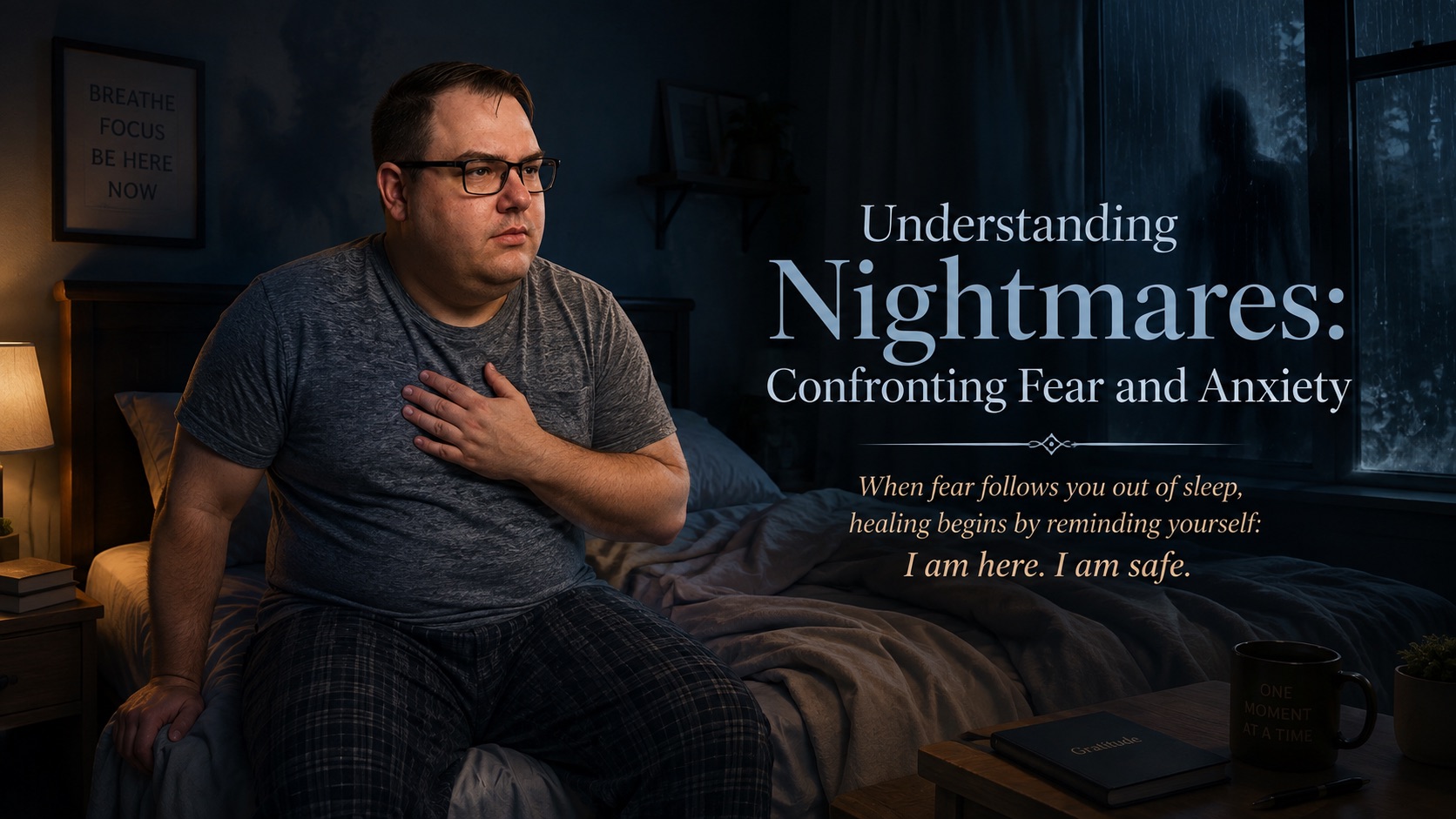
I remember how I talked about fear before — how it affects me, keeps me stuck in doubt, and makes me think the worst about myself. But it was not just fear by itself.
There was something else that came with it.
Nightmares.
That’s right. Nightmares.
Have you ever had a nightmare so intense that you felt like you were actually living inside it? Not just watching it happen, but feeling everything in it — the emotions, the pain, the fear, and the hurt. Even though you are asleep, your mind makes it feel real.
I have experienced that many times.
Every time I have one of those nightmares, it feels like that nightmare becomes my reality. I have always had the ability to remember my dreams, even the bad ones. Sometimes I remember them too clearly.
I remember one night when I woke up crying because, in the nightmare, I had hurt myself. I also remember dreaming that I was drowning. When I woke up, I was soaked in sweat and struggling to breathe because my brain still felt like I was underwater. It took a few minutes for my mind to snap back into reality and realize I was in bed, not trapped in water.
That is one of the hardest parts about nightmares. Even when they are not real, your body does not always know the difference right away.
The worst part of my nightmares is when I see a darker version of myself. It is like a shadow side of me, standing there and saying every cruel thing I already fear. It tells me I am not worth it. It tells me I was not supposed to be here. It tells me I was a mistake. It attacks my body, my mind, my confidence, and every vulnerable part of me it can reach.
In those dreams, I sometimes see myself cowering in a corner while that darker version of me tears me apart with words. The fear feels so real that, for a moment after waking up, I forget where I am. I have to remind myself that I am not still there. I am not still trapped in that nightmare.
Not every nightmare is about facing the dark side of myself. Sometimes the nightmares use people I know — family, friends, coworkers, or people I care about — and turn them against me. In those dreams, they say things I am afraid they secretly think. They push me down emotionally until I feel like I cannot breathe.
That is what makes nightmares so painful. They take familiar faces and twist them into something that hurts.
They take people I love and make them feel unsafe.
And the worst part is the lack of control.
Most of the time, I cannot stop it while it is happening. I cannot pause it. I cannot tell my brain, “This is not real.” I just have to live through it until I wake up.
But even waking up does not always end it right away.
Sometimes the nightmare follows me into the morning. I wake up shaken, heavy, depressed, or close to breaking down. My body is awake, but my mind is still trying to understand what happened. It takes time to separate the nightmare from reality.
I hate that part.
How I Try to Come Back From It
I wish I could say I know how to stop the nightmares completely, but I do not. I am still learning. What I do know is that when I wake up from one, I have to remind myself that I am no longer inside it.
Sometimes that means sitting up and looking around my room. Sometimes it means touching something near me, like my blanket, my bed, or the wall, just to remind my brain where I am. I try to tell myself, “I am awake. I am here. I am safe. That was a nightmare. It was not happening now.”
It does not always work right away. Sometimes my body is still shaking. Sometimes my chest is still tight. Sometimes the emotions from the dream stay with me longer than I want them to. But grounding myself helps me slowly come back to the present.
I have also learned that nightmares may need more than just “getting over it.” Sometimes they are connected to stress, fear, trauma, anxiety, or things your mind has not fully processed yet. That does not mean you are broken. It means your mind and body may be carrying more than people can see.
If someone else is experiencing this, I would tell them this: do not shame yourself for waking up scared. Do not call yourself weak because a dream affected you. Your body reacted to something that felt real in the moment, and that reaction deserves care, not judgment.
Some people find it helpful to write the nightmare down and then rewrite the ending while they are awake, making it safer or giving themselves control in the story. Others may need to talk to a therapist or mental health professional, especially if the nightmares keep happening or affect their sleep, mood, or daily life.
For me, the first step is learning how to wake up and remind myself that I survived the night. The nightmare may have felt real, but it does not get to decide who I am when I open my eyes.
I hate how something that happened in my sleep can affect the rest of my day. I hate how my mind can create a whole world of fear and then leave me to clean up the emotional mess when I wake up.
But I also know this is part of what I am trying to understand about myself. These nightmares are not just random scary dreams. Sometimes they feel connected to fear, anxiety, trauma, and the way I have learned to see myself over the years.
Maybe my brain is trying to process things it never fully knew how to handle. Maybe it is taking all the fear I carry during the day and turning it into images at night. Maybe the darkness in those dreams is not proof that I am broken, but proof that something inside me is still hurting and asking to be seen.
That does not make the nightmares easier.
But maybe it gives them a little less power.
I am still learning how to wake up from them and remind myself where I am. I am learning to breathe, look around the room, and tell myself, “I am here. I am safe. That was a nightmare. It was not real.”
Some nights are harder than others. Some mornings take longer to recover from. But I am trying.
And maybe that is the point.
Fear already takes enough from me during the day. I do not want my nightmares to keep taking pieces of me at night too.


Leave a Reply