
Content note: This post discusses panic attacks, emotional abuse, isolation, and thoughts about not wanting to be here.
I was 17 when I had my first panic attack.
I was still in high school and living in a dormitory. Nobody around me seemed to notice what was happening, but I noticed. I felt every part of it, and it was so intense that I had no idea what was going on.
The best way I can describe it is like sitting in the passenger seat of a luxury sports car that suddenly goes from zero to one hundred miles per hour in seconds. I was not driving, but my mind was.
My chest tightened. My arms became tense. I started sweating, and my brain felt like it was overclocked and moving at five hundred miles per hour. Most of all, it hurt.
That was the beginning.
Afterward, I felt ashamed. I could not tell anyone because I was afraid they would look at me differently. I worried they would pity me, think I was crazy, or believe I needed to be placed in a psychiatric hospital. I did not understand what had happened, so I kept it to myself.
Laughing With Friends and Falling Apart Alone
For a while, everything became quieter, but it never completely stopped.
I could still have good moments. I could joke around and be funny with my friends. People could see me laughing and probably assume I was fine. But after those moments ended, I would go right back into a corner inside my own mind.
I started thinking that everyone was out to hurt me or that nobody truly cared about me. I became harder on myself about everything, even something as small as spilling water on a table.
My first thought would be about how stupid I was.
That voice did not come from nowhere. It was connected to something another person had said to me many times. I heard it so often that I eventually believed it. Even when that person was not around, the words continued playing in my head.
A small mistake did not feel like a small mistake. It felt like proof that something was wrong with me.
My thoughts became darker. I started wondering where I fit into this world and why I was here. Once I went down that rabbit hole, many other things followed and pulled me even deeper.
Learning That Showing Emotion Was Dangerous
I grew up hearing that men were not supposed to cry.
I cannot say who taught me that because the person may read this, and there are parts of my story I am not ready to reveal publicly. What I can say is that when I cried, I was punished for it.
That stayed with me.
I learned that showing emotion could lead to pain. I learned to hide how I felt, keep everything inside, and pretend nothing was wrong. Even now, part of me understands that it is okay to talk about mental health, but another part still reacts with shame.
My logical mind may say, “It is okay to talk about this,” while my gut tells me that I have done something wrong just by being honest.
Living With Thoughts I Could Not Turn Off
I have lived with thoughts about not being here for almost thirty years. I am forty now, and this began when I was seventeen.
I have not acted on those thoughts, but that does not mean they were never there. Sometimes I imagined what would happen if I were gone. I thought about what the people around me would do without me and how sad some of them might be.
Thinking about the pain my absence could cause helped stop me from going further. It reminded me that my life was connected to other people, even during moments when I felt completely alone.
Knowing that did not magically make the thoughts disappear. That is something people may not always understand. You can know that you do not want to hurt others and still struggle with thoughts you cannot completely control.
For most of my life, I did not talk about it.
I recently opened up to a friend who has experienced some of the same things. At first, I felt relief. For once, I did not feel alone or like I had to explain every part of what was happening inside my head.
But the shame quickly returned. I started feeling like I should not have told anyone, even though I knew talking about it was okay.
Why Isolation Started Feeling Safer
Living with mental-health struggles is difficult, but it is also exhausting.
It can make you feel completely alone. Over time, I learned that staying in the darkness sometimes felt safer than going out into the world.
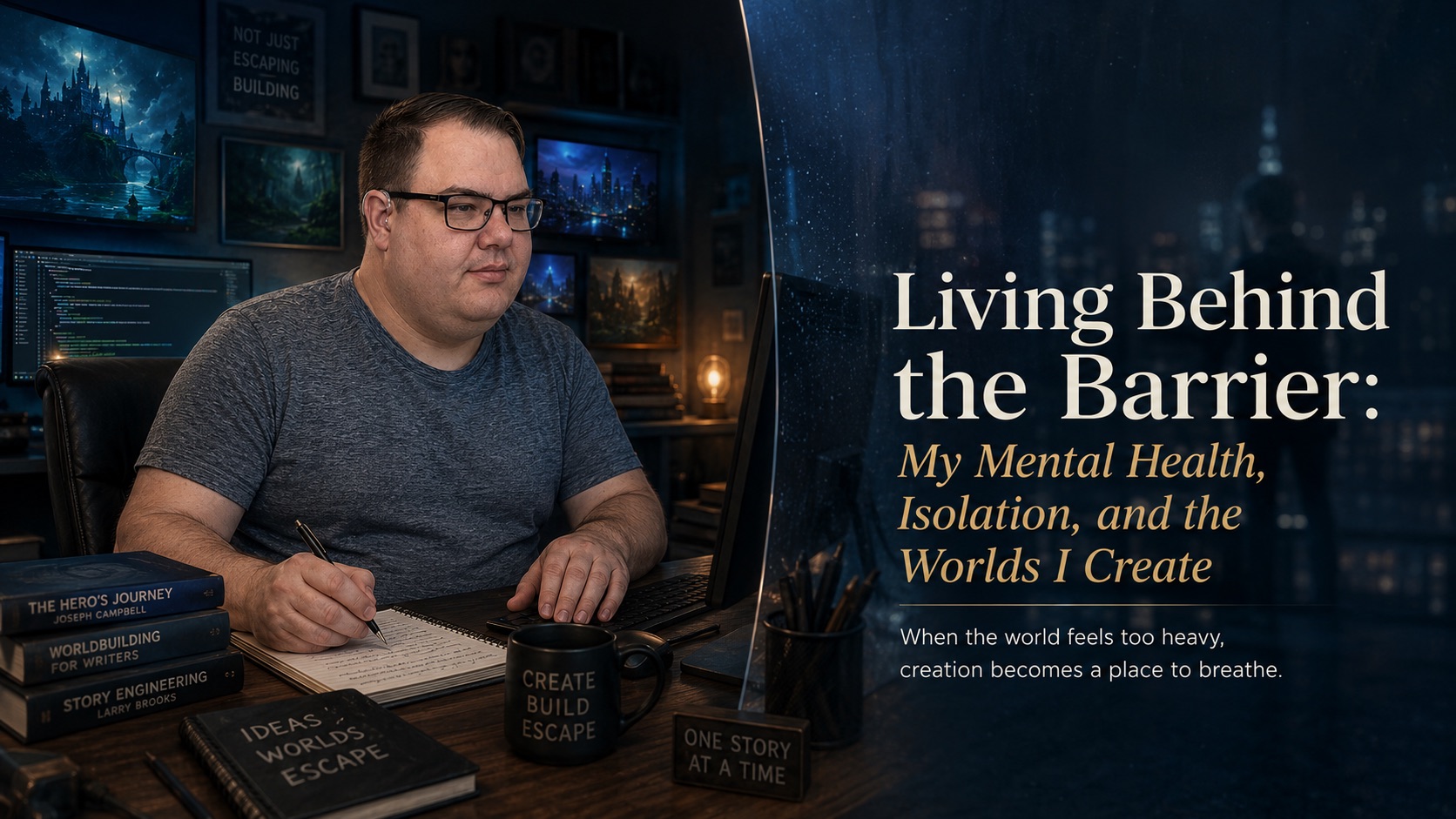
For me, that meant isolating myself and doing things alone. I would hide in my room with my computer and three televisions playing around me.
I do not necessarily mind being alone. Sometimes I enjoy it. But sitting alone in a completely dark and quiet room with only my computer can feel strange. When the televisions are on, there is movement, sound, and visual noise. It gives me the feeling that something is still happening around me.
The screens distract me, while working on my computer helps calm my thoughts.
When I am focused on a project, my mind has somewhere else to go.
Creating Became One of My Coping Tools
I enjoy creating websites, building a fansite for my favorite actor, creating games, and writing books.
These projects are more than things I do to pass the time. They give me focus. They allow me to take all the noise inside my head and place it somewhere else for a while.
When I am working, the thoughts become quieter.
Writing affects me in a different way because I can see the scenes playing inside my head. I watch the characters, study what is happening, and try to understand the scene well enough to put it into words.
For that moment, I am not focused on fear. I am focused on bringing a world to life.
When I finish creating something, I feel excited, but the excitement sometimes lasts only a short time. Then the worries begin.
What will people think?
Will they leave a bad review?
Will someone troll me or make fun of what I created?
Will anybody care about it at all?
I constantly check for reactions. Even when there is no reaction, my mind tells me that nobody liked it.
How One Bad Review Silenced Me
A long time ago, someone left a bad review of my writing. It made me believe that I was a terrible writer and that nothing I wrote made sense.
I also received a good review, which somehow made things more confusing. I did not know which person was right. The negative review was easier to believe because it matched the harsh voice already living inside my head.
For a while, it stopped me from writing.
Eventually, I remembered why I loved writing in the first place.
When I write, my fantasies come alive. Characters develop, stories grow, and worlds begin to exist that were once only inside my imagination.
I am writing again now, and people have told me that my work is very good. I am trying to hold on to those words. Some days I can. Other days, the old doubts break through again.
I am learning that returning to something you love does not mean the fear is completely gone. Sometimes it means continuing even while the fear is still talking.
Writing Parts of Myself Into My Characters
My books may be fantasy, but my pain and experiences often move through my characters.
I tend to write about survivors who are trying to find somewhere they belong while their own minds keep holding them back.
One of my characters begins his story isolated from his family and living in a difficult situation. He struggles with his mother, the man he believes is his father, and the feeling that he does not belong anywhere.
As his story grows, he discovers secrets about who he really is. He learns that he has powers, including telekinesis and the ability to create a protective barrier around himself.
Telekinesis gives him control over objects and the world around him, which connects to something I have often wanted in my own life: control.
But when he first discovers his power, it does not immediately make him feel powerful. It frightens him because he is already overwhelmed by everything happening around him. For a short period of time, he is hunted, and only then does he begin to understand that his abilities can protect him.
His barrier is especially personal to me.
Sometimes my character creates it on purpose. Other times, it appears automatically when someone attacks him. It protects him before he even has time to think.
That reminds me of the emotional barriers I have created in my own life.
What It Takes for the Barrier to Come Down
My character can lower his barrier when he trusts someone.
The first person he truly trusts that way is someone who becomes a source of understanding and safety in his life. This person does not treat him like a problem that needs to be fixed. When my character breaks down, he listens and speaks to him like a human being. He gives my character permission to be himself.
I think I wrote that relationship because I know what it feels like to need that kind of understanding.Only a few friends know that I write and that I am trying to write a book.
The more people who know, the more chances there are for criticism, bad reviews, or hurtful comments. Keeping my writing private feels like a way to protect it, but it also means hiding an important part of myself.
My books may be fantasy, but my pain and experiences often move through my characters.
I tend to write about survivors who are trying to find somewhere they belong while their own minds keep holding them back.
One of my characters, Zack, begins his story isolated from his family and living in a difficult situation. He struggles with his mother, the man he believes is his father, and the feeling that he does not belong anywhere.
As his story grows, he discovers secrets about who he really is. He learns that he has powers, including telekinesis and the ability to create a protective barrier around himself.
Telekinesis gives him control over objects and the world around him, which connects to something I have often wanted in my own life: control.
But when he first discovers his power, it does not immediately make him feel powerful. It frightens him because he is already overwhelmed by everything happening around him. For a short period of time, he is hunted, and only then does he begin to understand that his abilities can protect him.
His barrier is especially personal to me.
Sometimes Zack creates it on purpose. Other times, it appears automatically when someone attacks him. It protects him before he even has time to think.
That reminds me of the emotional barriers I have created in my own life. When someone hurts me, avoids me, stops texting, or does not believe what I am saying, I retreat completely.
I stop reaching out. I avoid people. I stay in my room, and I pretend I am fine.
From the outside, it might look like I want to be left alone. Inside, part of me is still hoping that a close friend or family member will notice that I disappeared.
What It Takes for the Barrier to Come Down
Zack can lower his barrier when he trusts someone.
The first person he truly trusts that way is his real father. His father does not treat him like a problem that needs to be fixed. When Zack breaks down, he listens and speaks to him like a human being. He gives Zack permission to be himself.
I think I wrote that relationship because I know what it feels like to need that kind of understanding.
A long time ago, I had a therapist who made me feel safe. He had a lot of energy, smiled often, was funny, kind, and completely himself.
More importantly, he made me feel like nothing I said made me bad or crazy.
I could speak without watching him pull away from me. I did not feel like I had to hide every uncomfortable thought or emotion.
When he was no longer part of my life, it strengthened another belief I have struggled with for years: everyone eventually leaves me.
That fear affects the way I connect with people today. When I try to explain it, some people become frustrated, blow it off, or tell me it was nothing. Others avoid me, stop talking to me, or act like they do not believe me.
When that happens, I retreat behind the barrier again.
I Do Not Always Know What I Need
One difficult part of living this way is that I do not always know what I want other people to say or do.
I know what hurts. Being ignored hurts. Being avoided hurts. Silence after opening up hurts. Feeling like somebody does not believe me hurts.
But after spending so many years hiding my emotions, I am still learning what support looks like for me.
Sometimes I do not need someone to solve everything. I may simply need them to remain present, listen, and not make me feel ashamed for being honest.
You Are Not Alone
The main reason I am sharing this is because I want others to understand that they are not alone.
It is okay to feel overwhelmed. It is okay to struggle, to have difficult thoughts, and to admit that you are tired. Those feelings do not make you weak, bad, or crazy.
At the same time, we have to learn what healthy tools can help us move through those moments.
For me, those tools include working on websites, creating games, writing books, surrounding myself with sound and visual noise, and speaking with someone who understands. None of those things erase everything, but they can quiet the thoughts and help me make it through the moment.
I am still learning how to live with my mind instead of constantly fighting against it. Some days, I still retreat. Some days, the fear becomes loud again. Some days, I still struggle to believe the good things people say about me.
But I am writing again.
I am creating again.
I am slowly learning when it is safe to lower the barrier.
Not everyone will understand you. Some people will be dismissive, cruel, judgmental, or simply an ass. Their behavior may have nothing to do with who you are or what you are worth.
Your pain is real, but so is your ability to keep moving forward.
And even when your mind tells you otherwise, you are not the only person fighting this battle.
A note to anyone struggling: Please consider speaking with someone you trust, a mental-health professional, or a crisis-support service in your area. You do not have to explain everything perfectly to deserve support. If you believe you may be in immediate danger, contact local emergency services or go to the nearest emergency department.


Leave a Reply